
Opinion: What you should know about going to Graduate School
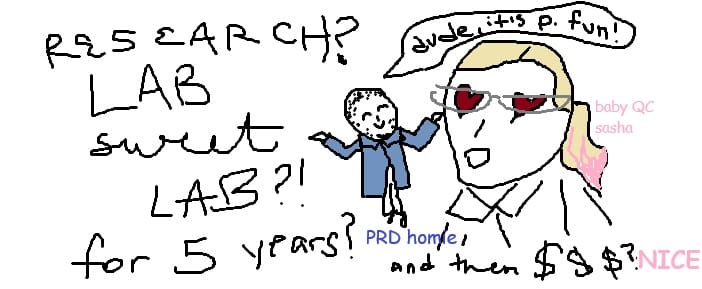
I can't speak to other fields, obviously, so know this comes from a chemistry perspective!
Why you should go: Starting salary with a B.Sc. in Chemistry is ~$40k (2018). Starting salary with a Ph.D. in Chemistry is listed as ~$68k, but I have a feeling that includes post doc salaries. Industry PhD starting salaries are usually at least $100k. Positions that require a Ph.D. are generally more intellectually involved and allow you more freedom as an individual contributor to pursue avenues that you think are effective as a lead on a project. The job types change too, and you can contribute scientifically at a higher level in the company you work for. Also, you can become a professor yourself, if that's your goal.Why you shouldn't go: Grad school is a lot of work and commitment and you barely get paid for 5 years, likely dead in the middle of your twenties. Research is not for everyone, and you have to have both the understanding of the science and what we sometimes call "the hands" (practical ability) to do research. A lot of people burn out.
"Ok, I think I'm going to go. What can you tell me?"
- Unlike medical school, you DO get paid to do a Ph.D. in Chemistry. Your tuition is covered by the university and you get a stipend based on cost of living in the area.
- The stipends are usually low - when I was at University of Houston, my stipend was $24k/year.
- In New York/California these are higher because the cost of living is.
- You can find out what to expect from resources like: www.phdstipends.com/results
- The stipend usually kicks in about a month after you start your program, so it's good to be prepared to spend a month without pay.
- You may have to be a Teaching Assistant for some/all of your Ph.D.
- Teaching assistants can either be assistants to a course/lab instructor, or BE the lab instructor, dependent on the university.
- The research professor you work for may be able to pay for your stipend with grants, and if they can, they usually do -- more time in the research lab = more productivity.
- You can also apply for fellowships (grants) to supplement your stipend! These are discipline/university/professor dependent, but are worth investigating and applying for.
- The general rule is that you have to have above a 3.0 GPA in undergrad to go to graduate school. Some programs are more restrictive, and some programs make exceptions based on personal circumstances.
- Some schools also have a specific major-related courses GPA requirement which may be higher than the overall average. So you may see something like "Not below a 3.0 GPA overall, not below a 3.25 in major-related courses". Any course that was a requirement for your major counts, and it's not usually shown on your transcript so you may have to calculate it yourself.
- Fewer and fewer schools are requiring the GRE at all, and fewer still the Chemistry GRE. This may be something to look into.
- There are LOTS of FREE resources to study for the GRE. You don't need to spend thousands on it, the exam is expensive enough. Also, sample size of n=1, but I took the GRE without studying the 1st time, and after spending 3 months studying the second time and got approximately the same score both times. It's a weird test.
- You will not have summer/winter/spring breaks.
- Graduate school is much more like a job - your PI gives you a set amount of vacation days (3 "work weeks" is typical, so if you're working 10 hours/6 days a week, this will be something like 18 days of vacation/year) and you have to "request off" when you plan to go.
- Most PIs also do not give automatic days off for national holidays. Our only 3 days off, besides the 18 vacation days, were 4th of July, Thanksgiving Day and Christmas Day, but you can use your vacation days to make a long weekend if you want.
- Some profs also give their students the time between Christmas and New Year's off (mine did).
Prospective grad students:  | Professors/graduate programs:  |
- A PhD in chemistry is 95% research.
- You take courses (usually just your first year) but you're still expected to be in the lab at the same time.
- I took 6 classes total during my PhD. I think this is a pretty standard amount across different programs.
- Most programs/professors expect a commitment of at least 60 hours in lab/week after your 1st year. The quantity of hours and the flexibility of schedules vary group-to-group.
- I worked probably between 50-80 hours/week in the research lab as a grad student, dependent on teaching schedules/how well my projects were going.
- You take courses (usually just your first year) but you're still expected to be in the lab at the same time.
- A PhD is much more like a Job than School.
- After the first year, you will spend most of your time working in the lab, but programs have other requirements too.
- These can include cumulative exams taken on a certain schedule that cover concepts learned in 1st year courses.
- There will almost certainly be at least one seminar you present, sometimes two (literature, independent research proposal, own research: some common student seminar topics).
- Some universities have students submit (an in some cases, present and discuss) independent research proposals on a new chemistry idea to their department
- You are not officially a Ph.D. candidate until you pass your candidacy exam, usually taken in the beginning of your 3rd year of studies.
- If you fail candidacy, you are typically given the option to leave with a research masters after writing a thesis.
- Most professors won't let you go to candidacy until they're sure you're going to pass.
- You'll also have meetings: group meetings with your research groups, small subgroup/1:1 meetings with your professor, and department seminars where professors from other institutions come to present their work. All of these things usually happen once per week, with a break or a different schedule during summer.
- After the first year, you will spend most of your time working in the lab, but programs have other requirements too.
- A typical PhD in chemistry takes 5 years.
- People do graduate early (not less than 4 years) and late (not more than 7) but most people do it in 4.5-5.5 years.
- Your boss largely decides when you're ready to graduate, but some programs and even some specific research groups have requirements about how many publications (and sometimes even how many 1st author publications) you must have to be able to defend your PhD.
- Some research specializations (i.e. total synthesis) do not publish as much as others (i.e. methodology). In some total synthesis groups, it's common to publish only once/not at all during the Ph.D.
- Some universities have a limit on how many years they subsidize tuition and how long they will guarantee a teaching position (and therefore stipend) for. This is a good thing to know upfront.
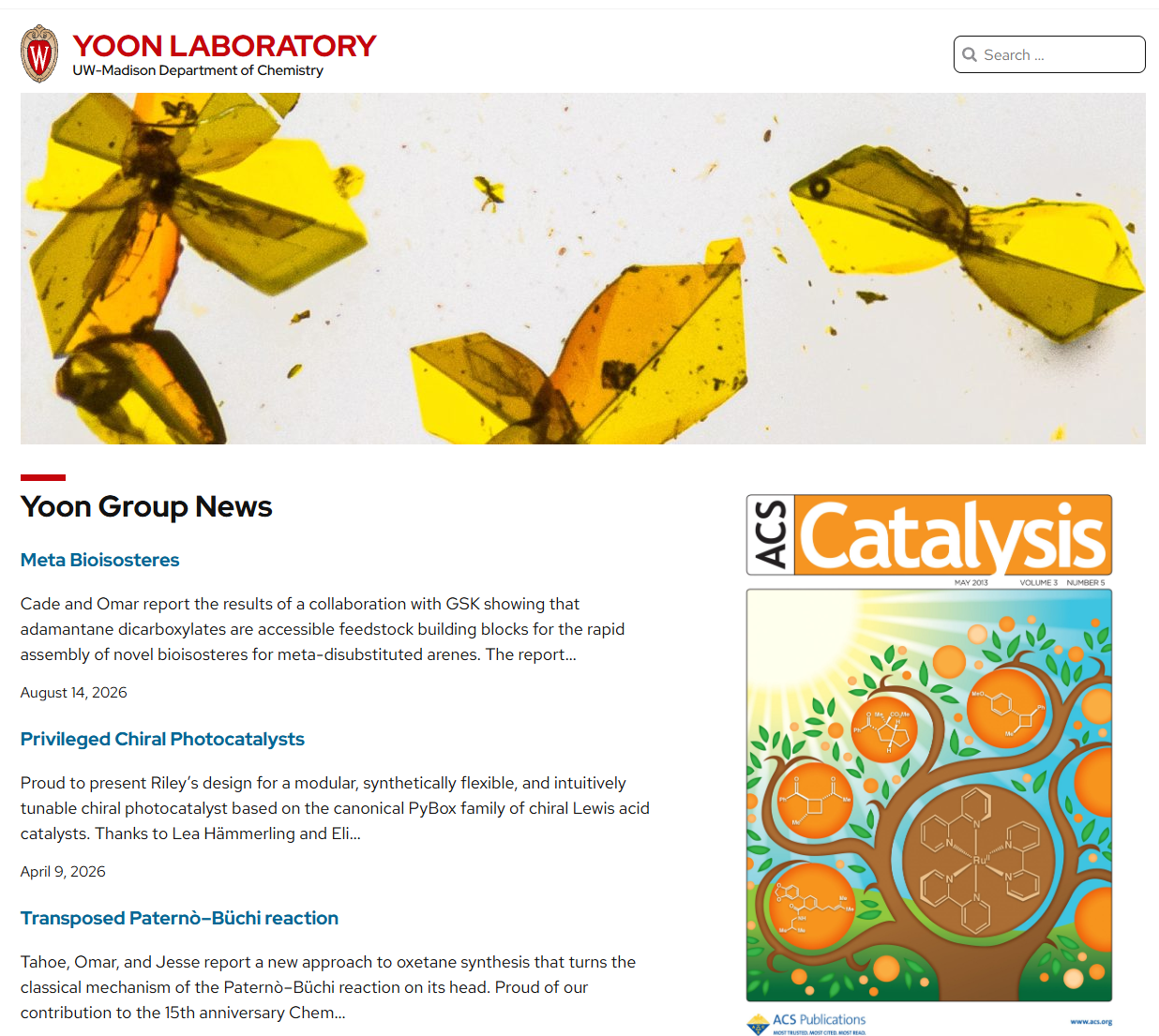
- When choosing a graduate program, pick a school where you can see yourself working with multiple professors in the department. Most (if not all) professors have a group website where they showcase their research, publications, and current/past students.
- For example, if you've heard good things about Wisconsin Madison, search something like "Wisconsin Madison chemistry faculty" and you should arrive somewhere like this:
- You should probably know which division interests you, by the time you're applying to Ph.D. programs, so click on the relevant one and explore what all the different professors focus on in their research:
- Some universities have research blurbs right on the faculty member's specific page, and for some, you have to actually go to their group website to learn more, which should also be linked in their bio.
- Once you've committed to a graduate program especially but to a professor specifically, it's not easy at all to switch professors, and especially not graduate institutions.
- It does happen that people switch advisors, but usually within the first year, two at a stretch.
- To switch institutions, you have to either quit your program and re-start at another, or get a masters from your institution... and re-start at another.
- It can be easier to get into high level programs with a Master's than with just a bachelors, so it's not a loss!
- If you start a Ph.D. program, you can decide to leave with only a Master's of Science, either course-based or research-based. Course-based can be done in 2 years, research-based takes approximately 3.
- Getting an MS can open you to new positions - above what you could get with a B.Sc. but not at the Ph.D. level.
- Master's degrees can be turned into very very cool open doors with some maneuvering, so it's not a "failure" but rather a pivot (if you play your cards smart)
- While there are "top tier schools" (I generally agree with this list), the most important determining factor for success is the quality of your research and commitment.
- If you come out of Cal Tech, you will certainly find a job, but even if you come out of somewhere like University of Houston (😉), if you worked really hard, published, and did the lab work, you will also be just fine.
- The most determining factor, in my opinion, for how well you do in grad school is your relationship with your PI (primary investigator, aka professor) and your interest in the chemistry their group does, therefore, choose someone who you get along with and who does chemistry you like.
- Talk to your prospective advisor not only about research, but their mentorship style, how they give/receive feedback, what connections they have to industry (if that's your eventual goal).
- Talk to your prospective advisor not only about research, but their mentorship style, how they give/receive feedback, what connections they have to industry (if that's your eventual goal).
 (grad students) |  PIs (ideally) |
- Most schools do rotations where you get to spend a few weeks working in different labs that are accepting new students. If you aren't sure what research you like, this can be a game changer.
- It can also give you a better idea of the vibes of the PI and the group in general, and decide if it's a place you can work for the next 5 years and be productive (and not absolutely miserable at the same time).
- If you're curious about something and want more info, just ask.
- Professors can be intimidating, but they're just people -- and usually, people who LOVE chemistry and love to talk about their research and their research groups. Their e-mail is right on that faculty page -- don't be afraid to reach out. The worst thing you'll get back is silence.
(An accurate depiction of a prof getting an e-mail from a prospective student)
- Your project in graduate school is chosen in collaboration with your advisor (PI/Professor).
- Some professors determine what students will work on, at least for their first project, without input from the student. This is normal, and is usually so your first project is something that gives you a good start to the research and a good avenue to publication -- not something you're likely to have a good gauge on as a 1st year student.
- Some professors will give you a list of projects to choose from. Have a dialogue both with them and with the other group members about this - sometimes the students will know/tell you things the professor wouldn't (i.e., this project has changed hands 5 times and no one can get it to work, stay away).
(In this metaphor, you're on the skateboard and the professor is pushing you along)
- While you do get a stipend and tuition is covered by the university, there are still costs & fees that you DO have to pay as a student at the university.
- These can be things like parking passes (at UH, for example, it was $500/year, due in September... with a stipend that was $1950/month), to be able to park on campus, health insurance, printing fees, student fees (just for.... existing on campus? UF's, for example, is $2 THOUSAND/year) etc.
- There is also sometimes "weirdness" with how the university counts your "hours", especially during the summer. If you have student loans from undergrad, this may even mean that you have to pay your loans for a summer because you're not considered a "student" during that time.
- Textbooks are also not covered by the university, and can be... pricey. You can, however, usually borrow them for an entire semester from a University library and older students are often willing to lend out textbooks for a semester while you're actively taking classes.
Your university will still be like:
- You will be given group job(s) along with your research responsibilities.
- These can be instrument maintenance, safety officer, inventory, ordering, group website, etc.
- Doing a good job at your group job is part of being a good coworker and maintaining a positive, supportive group culture.
- You never know where your peers will end up - the chemistry world is very small, and you want to leave a positive impression with as many people as you can.
- How much you care about your group job and how dedicated you are to ensuring everyone in the group has functional instruments/safe work environment etc. can be very indicative to hiring managers of how well you'll function in your post-PhD job. Just because your research is important doesn't mean that nothing else is.
- GO TO CONFERENCES!
- It's a good idea to ask your perspective boss up-front what their policy is for conference travel and if they cover any conferences at all and if they're even willing to let you go (not all PIs are).
- Conferences and networking in the chemistry world can be critical to finding a post-doc position or a job. Again - it's a small world, and the more people you meet and make a positive impression on, the easier it will be once you're done with your degree.
- "Be a good hang" (Summer Camaro, SNL band member RE: networking, for music school students)
- Be cordial, be pleasant, let your personality show if you're comfortable with that (or fake it if you're not)
- Present your research at every opportunity - not only is it good practice, it's a good way to be more visible.
- "Be a good hang" (Summer Camaro, SNL band member RE: networking, for music school students)
- ACS Conferences are fine, but look for other, more specialized ones that have a smaller attendee list. It's easier to be noticed when you're 1/200 people at a conference rather than 1/20000.
- GRS conferences, GRCs if you can swing it, NOBBChE, SACNAS, etc.
- Travel funding & grants are available through the ACS, through your graduate institution, through other institutions. Look for those opportunities and use them!
A conference. (👩💼: companies, post-doc advisors; 🐈s: graduate students)
- Personally, I think it's a good idea to go further from home for your graduate studies.
- There are less distractions and you can establish yourself independently of your undergraduate connections, which always looks good.
- You absolutely do need a good support system regardless - set up a group chat, call your supportive friends and family on Sundays, look into subsidized mental health care at your university, whatever it takes to stay sane.
Ok, that's all for now! I might add more things later as they come to me. Hope this helps someone! (:
Huge thanks for feedback and suggestions to Srujana Lam, Dr. Evgeniya Semenova, Dr. Stephanie Felten, Dr. Dmitry Eremin, Dr. Sebastien Laulhé, Dr. Jasper Luo, Dr. Elizabeth Jaekle, Dr. Kim Sharp, and Dr. Tom Barton (also thanks to Tom for encouraging me to write this in the first place)!